

Embark on a Journey
into Modern Physics
Spilling the beams on a new series of three books, 'A Journey Into Modern Physics'. Providing a fascinating ride through the subject for anyone with an enquiring mind and a thirst for knowledge. Minimum maths and maximum WOW factor! Links to Amazon to purchase E-book down-loads (free to anyome signed up with Kindle-Select) or paperback editions.
And now: using the Amazon free Kindle App, you can read the series on smart-phones, tablets, laptops and desktops.
Go to the main menu for more details.
A Journey into Modern Physics

A JOURNEY INTO MODERN PHYSICS
WELCOME
Here, you can learn all about the series;
A JOURNEY into MODERN PHYSICS
The series is now exclusive to AMAZON
and free to anyone signed up with
KINDLE-UNLIMITED
SORRY, but A Journey into Modern Physics is no longer available on RAKUTEN KOBO.
***** HOWEVER *****
You do not neeed a Kindle to read a Journey into Modern physics
If you load the free Amazon Kindle App, you can read a Journey into Modern Physics on phones, tablets, laptops or desktops.
Click below to learn more:
NOW AVAILABLE!
It's over a year since we published regular articles on physics to allow readers to continue the Journey into Modern Physics. We've put all the first year articles into an E-book and a paper-back, ON SALE NOW!

If you purchase the E-book edition, don't forget; you don't need a Kindle to read it! Down-load the Amazon Kindle App onto your phone, tablet, laptop or desktop to read the articles on the device of your choice.
If you are in KINDLE UNLIMITED, the E-book is free. ALSO: You can still continue to access the articles using the blog index. If you want more information or to purchase - go to the main menu.
A JOURNEY INTO MODERN PHYSICS
MAIN MENU
ABOUT THE SERIES
VIEW OR BUY ON AMAZON
INSIDE THE BOOKS
Scroll down for more options
NEW!
NEW!
What's the deal?
A series of three available titles
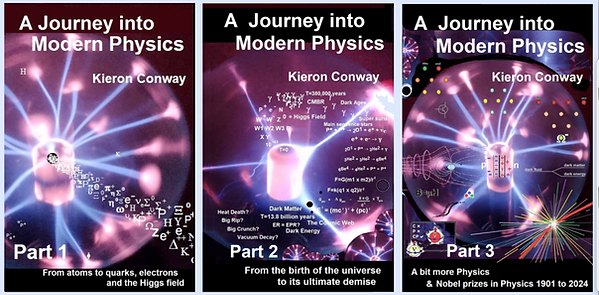
A fascinating journey into the world of modern physics in three parts.
Available as E-books or Paper-backs
AND
Also Available as LIGHT edition E-books
more suitable for younger minds (scroll down for more details)
All E-books are available as instant down-loads on AMAZON and are free with KINDLE UNLIMITED
Paper-back versions are available
The LIGHT Editions
A series of three adaptations
A NEW, LIGHT ADAPTATION OF THE MAIN SERIES
MORE SUITED TO YOUNG MINDS
A lighter version of the fascinating journey into the world of modern physics in three parts.
Available as E-books
All three parts are now available in the LIGHT adaptation of the main series.
Designed to bridge the gap between school science and university thinking.
Available on AMAZON and are free with KINDLE UNLIMITED
What's available?
A 3 PART SERIES FROM AMAZON
A down-load of each E-book to your device for a one-off cost.
A 6" by 9" paper-back with full colour images for a one-off cost.
(First, check your local AMAZON shop provides PRINT copies.)
A 3 PART LIGHT ADAPTATION FROM AMAZON
More suitable for young minds up to 18 years of age, designed to assist the transition between school science and university thinking.
NEW
All the physics articles, published in the the first year of this website's blog (Aug-25 to Jul-26), are now available in an E-book or paper back.
Return to main menu to view or buy any of the books.
What's it all about?
PART 1 & PART 1 - LIGHT
Starts by explaining what we know about atoms and sub-atomic particles and explains how our theories developed through experimentation.
Puts some of the theories into practice to show how the periodic table of atoms is constructed by nature.
Introduces some of the bizarre concepts in modern physics, leading up to how fundamental particles acquire mass through a mechanism that took forty years to verify.
PART 2 & PART 2 - LIGHT
Exposes all that we currently know about how our universe started, from the beginning to the point where the first galaxies formed.
The power of the sun (fusion) in all its glory, is laid bare, followed by radioactivity and nuclear fission.
Einstein's special and general relativity get three chapters dedicated to themselves.
The background to one of the most interesting modern theories in physics is thrown open before looking at what might end our universe
PART 3 & PART 3 - LIGHT
Entitled, 'a bit more physics', looks at symmetry, magnetism, semiconductors and the amazing history of accelerators at CERN. From CERN's beginnings in the 1950s to the present day and the mighty Large Hadron Collider, the largest accelerator on the planet. And, there's an even bigger one being planned for the future!
The final two chapters list all the Nobel laureates in physics from 1901 to 2024. Additional information is supplied where an award involved physics not mentioned in the series, expanding your knowledge up to the start of 2025.
Chapter headings
PART 1 & PART 1 - LIGHT
FROM ATOMS TO QUARKS, ELECTRONS AND THE HIGGS FIELD
CHAPTER 1
What's an Atom? (A gentle start!)
CHAPTER 2
How do we know about atomic structure?
CHAPTER 3
Can we shed light on the electron?
CHAPTER 4
How do electrons populate atoms?
CHAPTER 5
How do force interactions work?
CHAPTER 6
How do particles acquire mass?
PART 2 & PART 2 - LIGHT
FROM THE BIRTH OF THE UNIVERSE TO ITS ULTIMATE DEMISE
CHAPTER 7
What is known of the birth of the universe?
CHAPTER 8
How does nuclear fusion work?
CHAPTER 9
What is radioactivity & fission all about?
CHAPTER 10
It's all relative (special relativity).
CHAPTER 11
How can you model events in space-time?
CHAPTER 12
General relativity. An alterative to Newton.
CHAPTER 13
What is 'spooky action' all about?
CHAPTER 14
How will the universe end?
PART 3 & PART 3 - LIGHT
A BIT MORE PHYSICS & NOBEL PRIZES IN PHYSICS 1901 TO 2024
CHAPTER 15
Why is symmetry important in physics?
CHAPTER 16
What is magnetism? (magnets & fields)
CHAPTER 17
What are semiconductors? (our tech)
CHAPTER 18
What are the rings of CERN?
CHAPTER 19
Some of the early pioneers of physics - 1901 to 1960.
CHAPTER 20
More recent pioneers of physics -
1961 to 2024.
Topics & Headers
TOPICS
(applies to main & LIGHT editions)
examples are from main series
A page may contain a number of headers, which define the content of the topic that follows the header.
Sub-headers are also used to segment the contents of topics.
A topic may consist of a single paragraph before the next topic, or it may consist of a number of pages, depending on the complexity of the subject matter.
A header may be in the form of a question or a description of what is to follow.


Examples of headers on Mobile phone

Examples of headers on Kindle
Diagrams, tables & graphs
VISUAL AIDS
(applies to main & LIGHT editions)
Many topics have diagrams or tables, or even both, to assist in the topic's context, whether you are using an E-book, mobile or a paperback version of the title. The same images are used in both the main series and the LIGHT version.
Diagrams are in colour in the paper-backs and if you are using an E-reader that supports colour, such as Kindle-Colour, a tablet or a mobile.


Examples of Tables & diagrams


Examples of Graphs &
specialised tables
TOPIC INDEX
(applies to main & LIGHT editions)
All the headers and sub-headers are listed in the index at the front of the book. Clicking on an index entry in an E-book will take you directly to the topic on the right page.
Scan the index and you're just one click away from your topic of interest.
(main series)
For the paper-back, each index entry provides the correct page number, but you will have to get there on your own!


Electronic
index of all topics in
E-reader.
Full index with page numbers for paper-back versions
Scan the index for a topic of interest, click on the entry and you are taken directly to the topic.


GOOGLE SEARCHES
(applies to main & LIGHT editions)
Many topics provide search terms to use in Google, either to validate a topic's content, or to supply
further information
for deeper
understanding.

Google keywords defined and explained in italic section

Google keywords also defined in colour, where available.

Nobel Prizes 1901 to 2024
LIST OF NOBEL PRIZES
(applies to main & LIGHT editions)
The last two chapters in Part 3 list all the Nobel Prize winners in physics, from 1901 to 2024.
A basic description defines why the laureate(s) won the award, which could be for an invention, a ground-breaking experiment, a new theory, or for contributions to physics in general.
If the prize involves a subject that has not been covered in chapters 1 to 18, then a topic is included, which provides the missing details. In this way, the three part series brings you substantially up-to-date with modern physics.
Year and physicist(s) involved in the award


More about the series
Carry on the Journey.....
If you've managed to complete the Journey into Modern Physics by reading the three parts of the book series, then you're most likely to be the kind of person who will never stop exploring and learning all about our fabulous universe. Whatever you do in life, whatever your age, the wonders of the universe will never cease to amaze. To give you a helping hand on your extended journey, we have started a blog on this web site. Every couple of weeks or so, we now publish an article about some aspect of physics that you will find of interest.
Some articles are designed to give you a different perspective on something that you may have read in the series, some are designed to provide completely new material.
So, to continue your journey into modern physics, either go to the blog from the main menu, or head to the new index of blog articles and see what's available. From the index, you can access the article directly.
There's more......
We've also created a VIDEO WALL on which we've put links to all the third party videos that were recommended in the series. Click on the title of interest and you'll be taken straight to the video in a new window. Close down the window to return tp the web site. Give it a try.
AND......
We've added an IMAGE WALL on which significant images used in the series are posted. You can zoom in and out using your device to get the most out of the pictures, which contain lots of useful information. Give it a try.
AND......
All the recommended internet sites from the books, used to provide additional material on a given topic, have been added to a REFERENCE WALL. Hunt out a reference of interest and go straight to it.
Keep probing and keep asking our friend "Google" about the things that interest you, whether it's science, technology, engineering, or maths.
Have you ever wondered what lies beyond the realm of classical physics? Are you a young, curious mind with a passion for unraveling the mysteries of the universe? If so, "A Journey into Modern Physics" is the perfect series for you.
This captivating book series is designed for young scientists aged 16 to 18 who are eager to delve into the captivating world of modern physics. Whether you're interested in the smallest building blocks of matter or the grandest cosmic phenomena, these books will take you on an enlightening journey through the wonders of the universe.
From the intricacies of atoms and quarks to the enigmatic nature of the Higgs field, from the behavior of electrons to the cosmic dance of stars and galaxies, the series covers a wide range of fascinating topics. Explore the mysteries of the universe, learn about the birth and demise of the cosmos, and discover the groundbreaking achievements that have shaped our understanding of the physical world.
Each book in the series is carefully crafted to make complex concepts accessible to young readers, with minimal math and maximum clarity. Whether you're a budding physicist, an aspiring engineer, or simply a curious mind eager to learn, these books will ignite your passion for science and expand your horizons.
You can purchase the books as E-books or paperbacks on Amazon Kindle of Rakuten Kobo, with the option for KOBO users to download for free. Immerse yourself in the captivating world of modern physics, and embark on a journey of discovery and exploration. Who knows what wonders you may uncover along the way?
On the website, you'll find images of the book covers and links to purchase options. In the near future, a community forum will be created for young physics enthusiasts to come together and discuss the fascinating topics from the series. Join us on this exciting adventure into the realms of modern physics, and let your curiosity soar to new heights.
Explore Modern Physcis:
Exciting Topics for Young Scientists
Even when you finish the series of three books, the journey never ends as our understanding of the univere and everything about it, constantly evolves. Old theories may be modified to accommodate new findings and new theories will emerge as we explore further and further into the science that we call physics.
Back in the early 1980s, while working at CERN, Sir Tim Berners-Lee developed an idea to facilitate the sharing and upkeep of information from many contributors. In the late 1980s, CERN was the largest internet node in Europe and Sir Tim took the advantage of expanding his concept of hypertext into the internet and so was born the World Wide Web. With www, scientists across the globe were able to provide input, in many different forms, that allowed information to be shared and used for research purposes and teaching. Very quickly, www became the mechanism to inform, or to learn, across any subject you can name, from science to engineering; from art to history; from music to literature and so on and so on.
Then along came the search engines, which allowed you to find things of interest on what was rapidly becoming a colossal, global information base. Search engines have now reached phenomenal abilities and Google, with its AI capabilities, represents the ideal mate to explore physics, both past achievements and new.
Don't let the journey end.......
In reality - the Journey into Modern Physics never ends